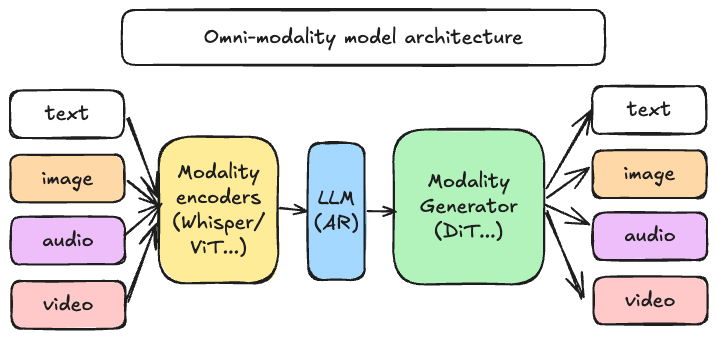
[2025/11] vLLM community officially released vllm-project/vllm-omni in order to support omni-modality models serving.
About
vLLM was originally designed to support large language models for text-based autoregressive generation tasks. vLLM-Omni is a framework that extends its support for omni-modality model inference and serving:
Omni-modality: Text, image, video, and audio data processing
Non-autoregressive Architectures: extend the AR support of vLLM to Diffusion Transformers (DiT) and other parallel generation models
Heterogeneous outputs: from traditional text generation to multimodal outputs
vLLM-Omni is fast with:
State-of-the-art AR support by leveraging efficient KV cache management from vLLM
Pipelined stage execution overlapping for high throughput performance
Fully disaggregation based on OmniConnector and dynamic resource allocation across stages
vLLM-Omni is flexible and easy to use with:
Heterogeneous pipeline abstraction to manage complex model workflows
Seamless integration with popular Hugging Face models
Tensor, pipeline, data and expert parallelism support for distributed inference
Streaming outputs
OpenAI-compatible API server
vLLM-Omni seamlessly supports most popular open-source models on HuggingFace, including:
We welcome and value any contributions and collaborations.
Please check out Contributing to vLLM-Omni for how to get involved.
Join the Community
Feel free to ask questions, provide feedbacks and discuss with fellow users of vLLM-Omni in #sig-omni slack channel at slack.vllm.ai or vLLM user forum at discuss.vllm.ai.