agent-substrate / substrate
- пятница, 21 августа 2026 г. в 00:00:12
Agent Substrate: the core system
NOTE: This is not an officially supported Google product. This project is not eligible for the Google Open Source Software Vulnerability Rewards Program.
Agent Substrate delivers a performant, high density runtime environment for large scale agent deployments. The agent substrate control plane provides full lifecycle management for agent sandboxes, delivering sub-second agent resume/suspend operations, and allows heavy multiplexing of agents onto the same computer infrastructure. It supports multiple sandbox technologies including microVMs and gVisor, enabling consistent lifecycle operations for all sandbox types.
At its core, Agent Substrate maps a larger set of “actors” (applications such as agents) onto a smaller set of ready “workers”, relying on the fact that agent-like applications tend to be idle most of the time to achieve heavy multiplexing. It provides functionality to manage an actor’s lifecycle (e.g. create/destroy, suspend/resume), to assign actors to workers in real time, and to route incoming traffic to them.
Agent Substrate is intended to be a low-opinion system. The workloads it manages don't have to be literal AI agents, but those are the best example of the kind of applications it is designed for. It is not an SDK for building agents, but rather a system for running them at scale.
Agent Substrate leverages Kubernetes for the infrastructure provisioning and worker lifecycle management (Kubernetes Pods). It builds on top of Kubernetes features like Pods and Pod autoscaling, while Agent Substrate provides agent-specific scheduling and control to achieve lower latency. Using Kubernetes as the underlying system enables consistent infrastructure management across all workloads types that are required for end to end agentic deployments and allows holistic infrastructure optimizations for RL scenarios that span agentic, inference and training cycles.
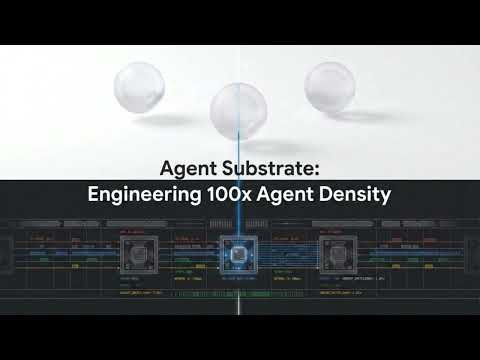
Watch the Agent Substrate cluster multiplex ~250 stateful actors across just 8 physical pods.
This demo highlights the core developer experience and "Agentic Infrastructure" capabilities of Substrate:
To reproduce this demo in your own cluster, please refer to the detailed walkthrough in the Counter Demo.
For more videos and walkthroughs, visit our YouTube channel: agent-substrate.
Agent Substrate is designed to be framework and agent harness agnostic. Because it manages standard OCI containers at the kernel level (via gVisor), it can host agents built on any stack.
Agent Substrate is currently in early development. It is not ready for production use, and the APIs are almost guaranteed to change. We are not making any guarantees about backward compatibility at this stage, and everything in this project may be changed.
Currently we aim to support the latest stable release of Kubernetes, and the previous minor release.
For announcements, technical discussions, and community support, please join the ate-dev Google Group.
We host a weekly community meeting every Thursday from 10:00am - 11:00am PST.
We also have channels in the CNCF slack; request an invite here if you don't have access.
Please see CONTRIBUTING.md for guidelines on contributing to the project. We welcome contributions of all kinds, but the project is VERY young. Our immediate focus is on building out the core system and demos, so we may not be able to review or merge contributions that don't align with those goals in the near term.
To quickly set up the complete environment:
Make sure you have Go, kubectl, and docker installed and configured on your dev machine. We will automatically manage other dependencies via Go, including kind.
Run the following steps:
# create cluster and local registry (IPv4; IP_FAMILY=dual|ipv6 overrides)
hack/create-kind-cluster.sh

# install ate, valkey, rustfs
hack/install-ate-kind.sh --deploy-ate-system

# install counter demo
hack/install-ate-kind.sh --deploy-demo-counter

# install kubectl-ate
go install ./cmd/kubectl-ate

# create an atespace (required before creating actors), then a counter actor in it
kubectl ate create atespace demo
kubectl ate create actor my-counter-1 -a demo --template=ate-demo-counter/counter

# port-forward the network router to bind to local port `8000`
kubectl port-forward -n ate-system svc/atenet-router 8000:80curl -X POST -H "Host: my-counter-1.demo.actors.resources.substrate.ate.dev" -i http://localhost:8000/Create and configure your environment file:
cp hack/ate-dev-env.sh.example .ate-dev-env.sh

# Edit .ate-dev-env.sh to match your project and preferences, then source it:
source .ate-dev-env.sh
Enable application-default credentials for gcloud:
gcloud auth application-default login --project=${PROJECT_ID}Provision the required GCP resources (GKE cluster, Redis, GCS, and IAM bindings):
go run ./tools/setup-gcp bootstrapDeploy the Agent Substrate system to your cluster:
./hack/install-ate.sh --deploy-ate-systemYou can then deploy the sample applications. See demos/counter/README.md or demos/sandbox/README.md for detailed walkthroughs.
./hack/install-ate.sh --deploy-demo-counterYou can run individual setup steps to create GCP resources as needed. See go run ./tools/setup-gcp --help for available options. For example:
go run ./tools/setup-gcp create cluster
go run ./tools/setup-gcp create bucket
Similarly, you can deploy or cleanup specific Agent Substrate components using the installation script. See ./hack/install-ate.sh --help for all options.
# Re-deploy only ate-apiserver of the ATE system
./hack/install-ate.sh --deploy-ate-apiserver

# Delete everything (core system and all demos)
./hack/install-ate.sh --delete-allIf you need to delete the resources created by the setup script, you can use the provided script hack/teardown.sh. This script will delete resources in the reverse order of creation and handles partial failures gracefully.
./hack/teardown.sh --allOr run individual teardown steps as needed (see ./hack/teardown.sh for available options).
If you need to delete the local kind cluster and its registry (if it was created by hack/create-kind-cluster.sh):
./hack/delete-kind-cluster.shWe provide several sample applications demonstrating Agent Substrate's capabilities:
ActorTemplates running different binaries share one WorkerPool, across three namespaces.503.WorkerPool on its assigned-worker count with an HPA fed by prometheus-adapter.kubectl-ate.cmd/ateapi: The core control plane API server exposing gRPC endpoints to manage actor and worker lifecycles.cmd/atelet: A node-level DaemonSet that supervises physical worker pods, coordinates snapshotting, and manages state transfers.cmd/atecontroller: A Kubernetes controller that reconciles WorkerPool and ActorTemplate custom resources.cmd/atenet: A combined networking controller providing DNS, Envoy routing, and proxy sidecars.cmd/ateom-gvisor: An interior-pod helper running inside sandboxed worker pods to execute runsc checkpoint and restore commands.cmd/ateom-microvm: The micro-VM peer of ateom-gvisor, running actors as cloud-hypervisor VMs.cmd/podcertcontroller: A "polyfill" that provides Pod Certificate signers that
will eventually ship in upstream Kubernetes (with different names).cmd/kubectl-ate: A CLI tool for managing Agent Substrate resources. See its README.cmd/benchmarking: Synthetic workloads used by the load tests, including glutton, which consumes RAM, disk, and file descriptors on demand.tools/setup-gcp: A provisioning utility to set up the necessary GCP infrastructure resources (GKE, GCS, IAM).demos/: Sample applications demonstrating Agent Substrate capabilities.